Conscious Ageing

No matter how old a person is or how close they get to the door of exit, the calling keeps calling. A person can awaken at any point along the path of life.
Michael Meade
We have become accustomed to the narrative that ageing means decline, letting go, increasing weakness, increasing illness, decreasing opportunities, increasing forgetfulness and, in the end, death, the inexplicable – at least if we no longer follow a religion that promises us resurrection after death.
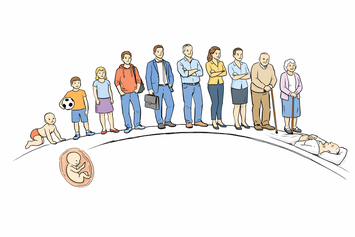
The arc of life is a metaphor and the basis of our cultural thinking about age, and all the elderly people before us and many of those we are currently accompanying seem to confirm this assumption with their life stories.
Image created with ChatGPT
The counter-image is the desire for anti-ageing, for a (permanent?) halt or even reversal of the aging process, which—if taken to its logical conclusion—could only be achieved in the current form of humanity for a few individuals at the expense of others.
I, on the other hand, see ageing as a phase of growth, as an independent phase of development of consciousness, as a period of life in which the individual potential in each of us can reach full
maturity and completion – without denying the possibility of increasing frailty, illness, pain and the approaching end of this physical existence. The concept of “eternal life” is, in my
understanding, a kind of state of consciousness, and possibly to be understood as what is referred to as realized awakening in Eastern traditions.
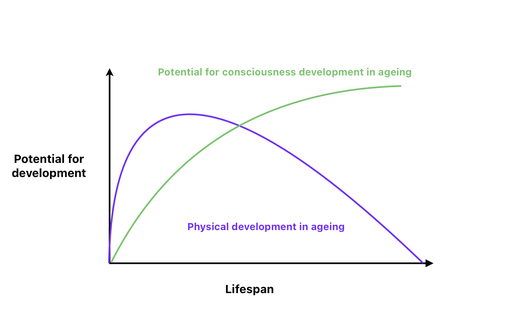
This includes the growing awareness of the transcendence of one's own personal being and the completion of the experience of this being in the transition from physical existence. In the best case scenario, the end of physical existence can occur at the peak of realised consciousness potential.
The experience of a personal ‘I’ will dissolve, that is inevitable – at least in the last moment of existence – and that is the greatest insult our ego experiences when it becomes aware of this. In my view, ageing is the time when we can and should finally face this insult to the ego, after the many activities of early and middle adulthood have distracted us from it for so long.
For me, conscious self-dissolution is part of the evolutionary potential and evolutionary task of aging. Conscious self-dissolution refers to the opposite of unconscious dissolution of the self, as it occurs in dementia - I have written more about this here.
Conscious aging, as I see it, involves not only a willingness to continue personal development and maturation, but also a willingness to take responsibility for the state of humanity, the ecosystem, the planet, and the cosmos, in whose current condition every human being has a share.
As we grow older, we play a significant role in the respective situation of our world, both our inner and outer worlds. We have helped to create it and we continue to shape it in every moment,
- with our physicality,
- with our life choices and actions,
- with our thoughts, emotions, and values,
- with the resulting behavior,
- with our awareness of our consciousness,
- with our awareness of the transpersonal nature of our being,
- and, last but not least, in our determination to take the developmental steps toward a planetary and cosmic consciousness
- or even beyond.
How can I live responsibly for myself into old age?
How can I live in accordance with my life's purpose and meaning?
How can I embody what wants to express itself through me in this life?

Support on the research journey through ageing
I offer intensive, in-depth and sophisticated support for individuals, projects and institutions. I accompany you online and in person, in individual sessions or in longer-term processes.
I draw on my understanding of transpersonal gerontology, which sees the increasing transcendence of the self as a task of ageing, incorporate the concept of an integral life practice for conscious ageing as needed, work with insights from classical gerontology and related sciences, and, depending on the context, draw on aspects of the Gene Keys, Human Design, astrology, and the Enneagram—and in doing so, I am rooted in the awareness of the various dimensions of consciousness, which are always present and effective and each require their own methods and approaches to understanding. In short, I accompany you in the context of your current issue, e.g.,
- Your own spiritual development/consciousness in ageing
- Preparation for or reorientation in retirement
- Uncertainty about signs of forgetfulness
- The onset or advanced stages of disorientation in your own being (more on this under Dementia transcendence)
- Accompanying a person with dementia
- Perspectives and experiences beyond the classical material world view that you would like to share
- Experiences of self-dissolution due to spiritual experiences or extraordinary experiences of consciousness
- The dying process in which you are consciously aware of yourself
- Accompanying another person through the process of dying
Conscious ageing & altered states of consciousness
A conversation with me can be helpful if you have had extraordinary experiences at some point in your life, experiences of emptiness, nothingness, near-death or unity experiences, which you have rarely or never spoken about before.
According to my research, acknowledging and classifying these experiences and integrating their effects on one's own identity and sense of self seems to be an important criterion for cognitively oriented ageing. Based on my own experience of nothingness and a challenging integration process that lasted several years, we may speak a similar language here about the seemingly unspeakable.
In general terms: if you want conscious, integral, transpersonal, or unitary reflection and support for your issues in aging, without denying the requirements of physical existence in aging and dying, conversations with me may be helpful for you: [email protected]
The conversations with me require personal responsibility and are not a substitute for therapy.
Conversations with people in phases of disorientation,
with cognitive challenges or a diagnosis of dementia are also subject to personal responsibility.
If necessary, a separate framework will be agreed upon.